


ETUDES DE CAS MBENEFITS
Bénéfices multiples de l’efficacité énergétique
23 évaluations pilotes en collaboration avec 20 entreprises dans l’UE, en Suisse et aux États-Unis
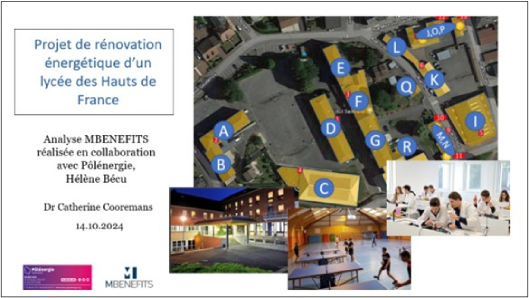 .
. 

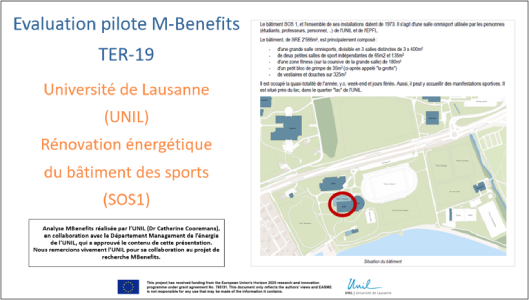
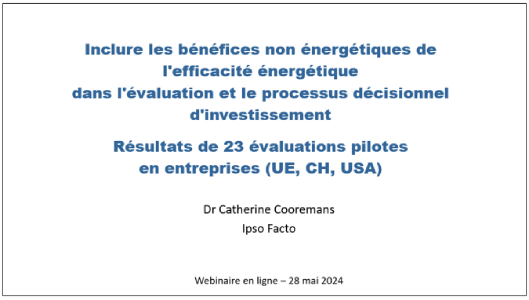
Notre article “Integrating the non-energy benefits of energy efficiency into business decision-making: results of 23 pilot assessments in European companies” résume les résultats des projets pilotes réalisés dans le cadre
du projet de recherche européen M-Benefits. Il est accessible en suivant le lien ci-dessous
https://www.aceee.org/sites/default/files/pdfs/ssi23/3-91-Cooremans.pdf
AUTEURS
Cooremans, Catherine, HEC Faculty of Business and Economics, Department of Strategy, Globalization and Society (SGS), Université de Lausanne Bonardi, Jean-Philippe, HEC Faculty of Business and Economics,
Department of Strategy, Globalization and Society (SGS), Université de Lausanne Killip, Gavin, Environmental Change Institute, University of Oxford Lung, Robert Bruce, Senior Technical Advisor, U.S. Department of Energy
ABSTRACT
Energy efficiency investments have a wide range of non-energy benefits (NEBs) that far outweigh their energy benefits. Unfortunately NEBs are not included in investment evaluations, due to a general lack of data, methodology and skills. Meanwhile an under-investment in energy efficiency is observable across all countries and business activities. In this context, the aim of this paper is to present the findings of a recent EU research which focused on the evaluation of investment projects at the level of industrial or service companies. The objectives of the research were threefold: 1) to contribute to the knowledge of the non-energy benefits associated with energy efficiency investments 2) to test a new approach to increase the uptake of energy efficiency investment. 3) to build up a solid knowledge base to describe and compare NEBs. In line with the double theoretical framework applied, this research sought to evaluate NEBs in financial terms but also in strategic terms, ex-ante, i.e. before investment implementation, a first in the field. This paper first synthesizes the literature on non-energy benefits that was extensively reviewed at the outset of the project, and describes the dual theoretical framework for investment decisions that can be used to study NEB. It then briefly describes the methodology for and the results of 23 pilot evaluations in the EU, Switzerland and the US. It is concluded that the new method proposed increases the attractiveness of energy-efficiency
investments and opens a concrete way to reduce the energy-efficiency gap.
Keywords: Investment decision-making; corporate strategy; energy-efficiency investment; multiple benefits of energy efficiency; non-energy benefits


